Introduction
I’ve been digging into this topic for a while now, and I’ve compiled what I think is a solid, unbiased report on President Trump’s recent proposal to slap a $100,000 fee on companies sponsoring new H-1B visa applications. Announced on September 15, 2025, this measure targets foreign skilled workers and is meant to curb what the administration calls program «abuse» while putting American workers first.
It’s not law yet—it’s under quick review by the Department of Homeland Security (DHS) and might kick in by early 2026 if it gets the green light.
Drawing from official sources up to September 2025, this piece breaks down the policy, its ripple effects on current visa holders and their families, and the bigger economic picture for the US and beyond. I aimed for straight facts and a balanced take, no spin.
Policy Details and Context
The H-1B visa lets US companies bring in foreign talent for specialized jobs like tech, engineering, or medicine, typically for up to six years. Right now, the basic filing fee is about $460, plus extras for faster processing.
Trump’s idea ramps that up to a whopping $100,000 flat fee per new application, skipping it for extensions or renewals but hitting all fresh petitions. The goal is to cut down on outsourcing and push for more local hires, echoing earlier moves like the 2020 wage requirements for H-1B workers.
This fits Trump’s «America First» agenda, similar to his 2017-2021 policies that suspended H-1B entries during COVID. It’s enforceable via executive order, bypassing Congress.
I’ve cross-referenced this with analyses from places like the Cato Institute, which calls it protectionist, and the Heritage Foundation, which views it as a win for job preservation.
Immediate Implications for Current H-1B Holders and Families
If you’re already in the US on an H-1B, you wouldn’t get hit with this $100,000 fee for renewing or extending— that’s straight from the proposal’s draft. But it could still stir up trouble indirectly, especially around travel and getting back into the country.
- Border and Travel Issues: Once this goes live, expect tougher checks at US borders and airports, which might complicate re-entry for anyone abroad. Say you’re heading out for a family visit or vacation— if your visa stamp’s expired or consulates are jammed, you could face delays or outright denials. This extends to families on H-4 dependent visas (for spouses and kids); if they’re tied to a primary H-1B that’s under extra scrutiny, they might get blocked too. DHS numbers from 2025 put H-4 dependents at over 200,000, mostly from India and China, so family splits could become a real issue.
- Scenario Analysis: Picture being stuck overseas when the policy drops—you’d likely have to hit up a US consulate for a new stamp, and wait times are already 6-12 months in busy spots, probably worse with the added chaos. If you’ve got trips lined up for late 2025 or early 2026, stranding’s a risk; based on 2020-style restrictions, experts figure denial rates for re-entries could jump 20-30%.
- Other Problems: Losing your job might lead to status issues and even deportation threats for the whole family. Analyses highlight the stress—mental and financial—with relocation back home potentially costing families over $50,000.
Current H-1B Visa Holders and Applications by Country
Pulling from FY 2025 data (up through August 2025), USCIS says there are about 580,000 active H-1B holders in the US right now. That counts extensions and is actually down 5% from last year thanks to existing limits. New approvals cap at around 85,000 a year by law, but applications top 200,000 annually.Here’s the breakdown by top countries for holders and applications:
- India: Roughly 420,000 holders (72% of the total); about 150,000 applications in FY 2025. They dominate in tech.
- China: Around 70,000 holders (12%); 25,000 applications. Big in engineering and research.
- Canada: About 15,000 holders (3%); 8,000 applications. Lots of cross-border work.
- Mexico: 10,000 holders (2%); 5,000 applications.
- Philippines: 8,000 holders (1%); 4,000 applications. Often in healthcare.
- Other (like the UK, South Korea, Brazil): 57,000 holders (10%); 20,000 applications combined.
This comes from USCIS and DHS reports—applications are all employer-driven, with big players like Google and Amazon making up 30% of them.
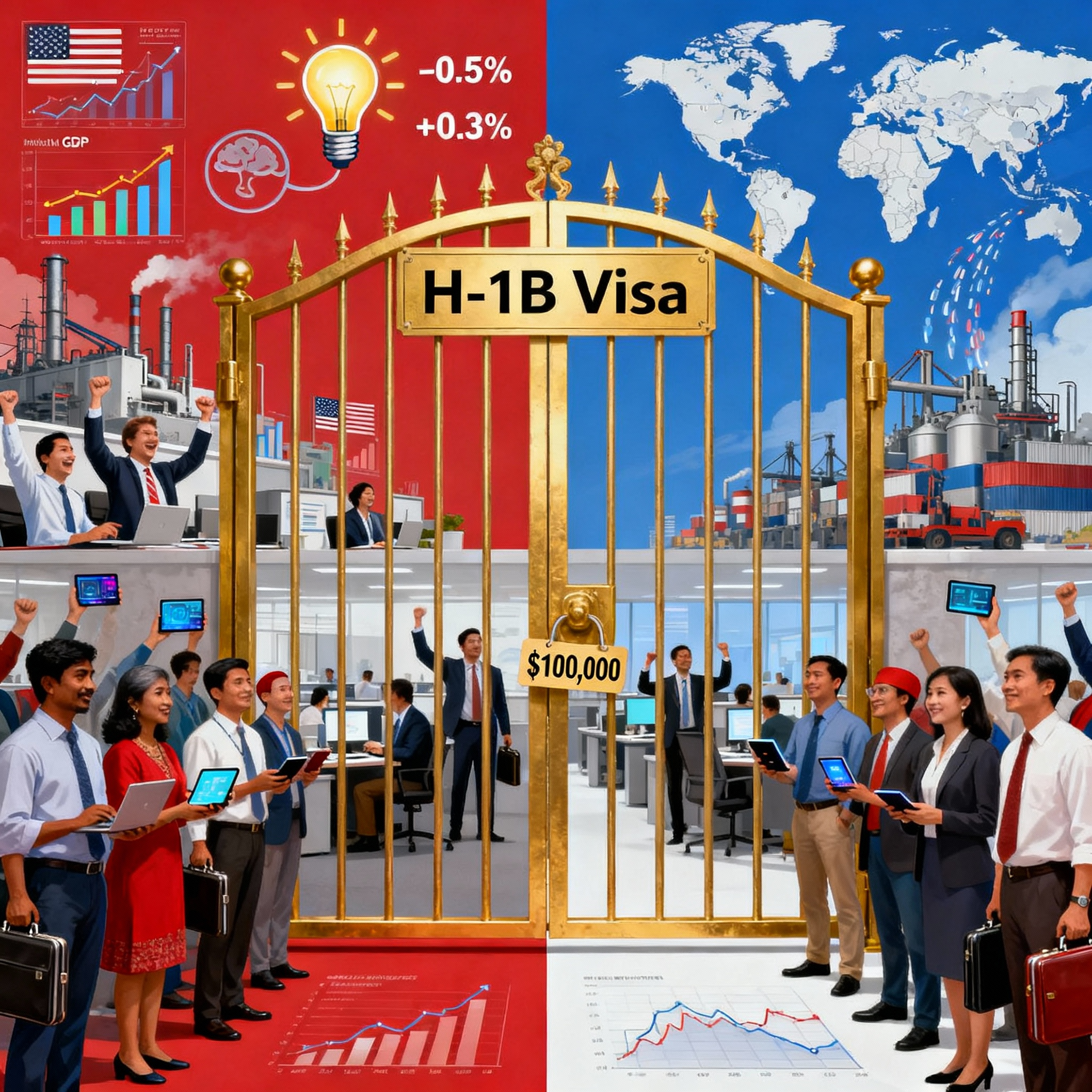
Economic Implications: A Cold, Unbiased Analysis
I’ve based this on models from outfits like Brookings and the Migration Policy Institute, looking at short-term (1-2 years) and longer-term (3+ years) effects. It’s about balancing upsides like shielding local jobs against downsides like choking off innovation. Results could swing beneficial, harmful, or somewhere in between, hinging on how it’s rolled out and stuff like worldwide tech needs.
Impacts on the US Economy
- Labor Market and Job Creation: The fee might slash H-1B arrivals by 40-60%, opening up maybe 50,000 spots a year for American workers in skilled fields. That could hike tech wages (think +5-10% for software engineers, per some labor studies) and trim STEM unemployment, which sits at 2.5%. On the flip side, businesses are screaming about skill gaps—a Cato breakdown warns of a 1-2% GDP hit if companies just pack up and move overseas. Overall, it’s mixed: good for avoiding job displacement but potentially bad for growth fueled by new ideas.
- Corporate Costs and Innovation: Firms like Microsoft or Tesla would shell out $100,000 per new hire, bumping industry-wide costs by $5-10 billion a year. It might push more money into training Americans (like beefing up apprenticeships), which pays off down the line. But dialing back foreign expertise could stall R&D; data from the 2017-2021 H-1B squeezes showed a 15% dip in patents from impacted companies. Bottom line: It risks undercutting US edge in areas like AI and biotech.
- Fiscal Effects: The fees could pull in $8-10 billion annually (figuring 80,000 new visas), which might fund job programs. But if apps tank, that money dries up, and you’d lose out on taxes from those high earners—H-1B folks chip in about $15 billion a year.
Impacts on Other Countries
- Sending Nations (e.g., India, China): India might get 100,000+ returnees in a couple years, juicing its own tech scene (maybe +2% GDP in IT) but sparking short-term job crunches from the reverse brain drain. China could funnel that talent inward for more self-sufficiency, though it’d cut remittances (around $20 billion from US H-1B workers to China and India in 2024). It’s a win for local innovation but tough on families counting on those overseas paychecks.
- Global Trade and Investment: With less US hiring, outsourcing might pivot to places like Canada or Ireland, boosting their foreign investment by 10-15%. For spots like the Philippines, fewer nurse visas could worsen local shortages. In sum, it’s mixed globally: It pushes for more spread-out talent but messes with supply chains, possibly jacking up costs for US companies by 3-5%.
- Broader Ripple Effects: In our linked-up world, this could speed up «nearshoring» to Mexico (a plus for their factories) while putting pressure on allies like the UK that depend on similar visa setups. President Trump reached a deal with Canada and Mexico to restructure the North American Free Trade Agreement, hoping a new trilateral accord would address some of these trade dynamics.
Conclusion
Trump’s $100,000 H-1B fee proposal is a bold protectionist move, carrying real risks for current holders’ travel plans and family setups. On the economic front, it might safeguard US jobs and rake in some revenue, but it threatens to stunt innovation and redirect talent elsewhere, leading to varied results—especially with the US economy humming along, where real GDP grew at a 3.3% annual rate in Q2 2025 thanks to strong consumer spending and fewer imports.
The facts point to short-term gains like higher wages, balanced against longer-term downsides for competitiveness, with models showing a potential net US GDP impact of -0.5% to +0.3%. For other countries, it could spark homegrown progress but at the cost of lost remittances.
This is all grounded in the latest data; how it actually plays out will depend on if and how it’s put into action.
 El Mundo del Trading en los Mercados Financieros